
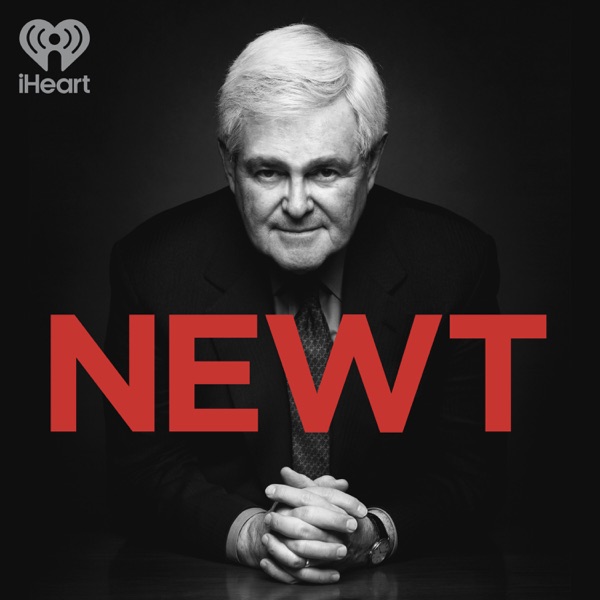
Newt's World
gsloan@gingrich360.com
For verified host and producer emails, sign up to view.
Booking Overview
Metrics
Episodes: 1033
Frequency: Multiple_weekly
Rating: 4.6/5.0
Estimated listeners: >100k
Gender skew: Unknown
Location: USA
YouTube: 15.9k subscribers
Instagram: 325.0k followers
Contact Information
gsloan@gingrich360.com
For verified host and producer emails, sign up to view.
Host
Newt Gingrich - Former Speaker of the U.S. House of Representatives and a historian with a Ph.D.
Booking Intelligence
Booking Requirements
Recent Guest Discussions
George Beebe - The Ukraine War, Russia, Diplomacy, Ai-guided Drones, European Security, And Nuclear Escalation Risks
Richard Battle - American History, Patriotism, Political Leaders, Military Figures, Civil Rights, And Technological Innovation
Rick Scott - The Senate's Legislative Role, Election Legislation, Government Shutdowns, Healthcare Transparency, And Federal Deficits
Episodes
Episode 1023: Greatest American Inventions — The Moving Assembly Line
August 04, 2026
Henry Ford didn't invent the automobile—he invented a way to make it affordable. Newt examines how Ford's 1913 moving assembly line cut Model T production time from 12.5 hours to 93 minutes, and how Ford's controversial $5-a-day wage turned his own workers into customers, helping create the American middle class. But this episode doesn't shy away from complexity: the same system that built American prosperity was also dehumanizing for many workers, and Ford himself was a deeply flawed f...
Episode 1022: Greatest American Inventions — The Personal Computer
August 03, 2026
For thirty years, a computer was something only governments and corporations could own—an entire room of machinery. Newt tells how that changed in 1975, when a $439 kit computer on the cover of Popular Electronics inspired a Harvard student named Bill Gates and an HP engineer named Steve Wozniak to imagine something radical: a computer anyone could own. From Microsoft's garage-built software to Apple's Apple II to IBM's industry-legitimizing PC, this episode traces how outsiders—n...
Episode 1021: Greatest American Inventions — The Internet
August 02, 2026
On the night of October 29, 1969, a UCLA student typed two letters into a Stanford-bound terminal before the system crashed—and the internet was born. Newt traces ARPANET's Cold War origins as a decentralized network built to survive nuclear attack, through Vint Cerf and Bob Kahn's TCP/IP protocol, to Tim Berners-Lee's World Wide Web. He argues the internet's true significance lies in a policy choice: the U.S. government built it, then let it go, handing an open network to the world rat...
Try us risk free with a FREE 3 days trial.
Join hundreds of PR teams using Podseeker to pitch and land bookings


