
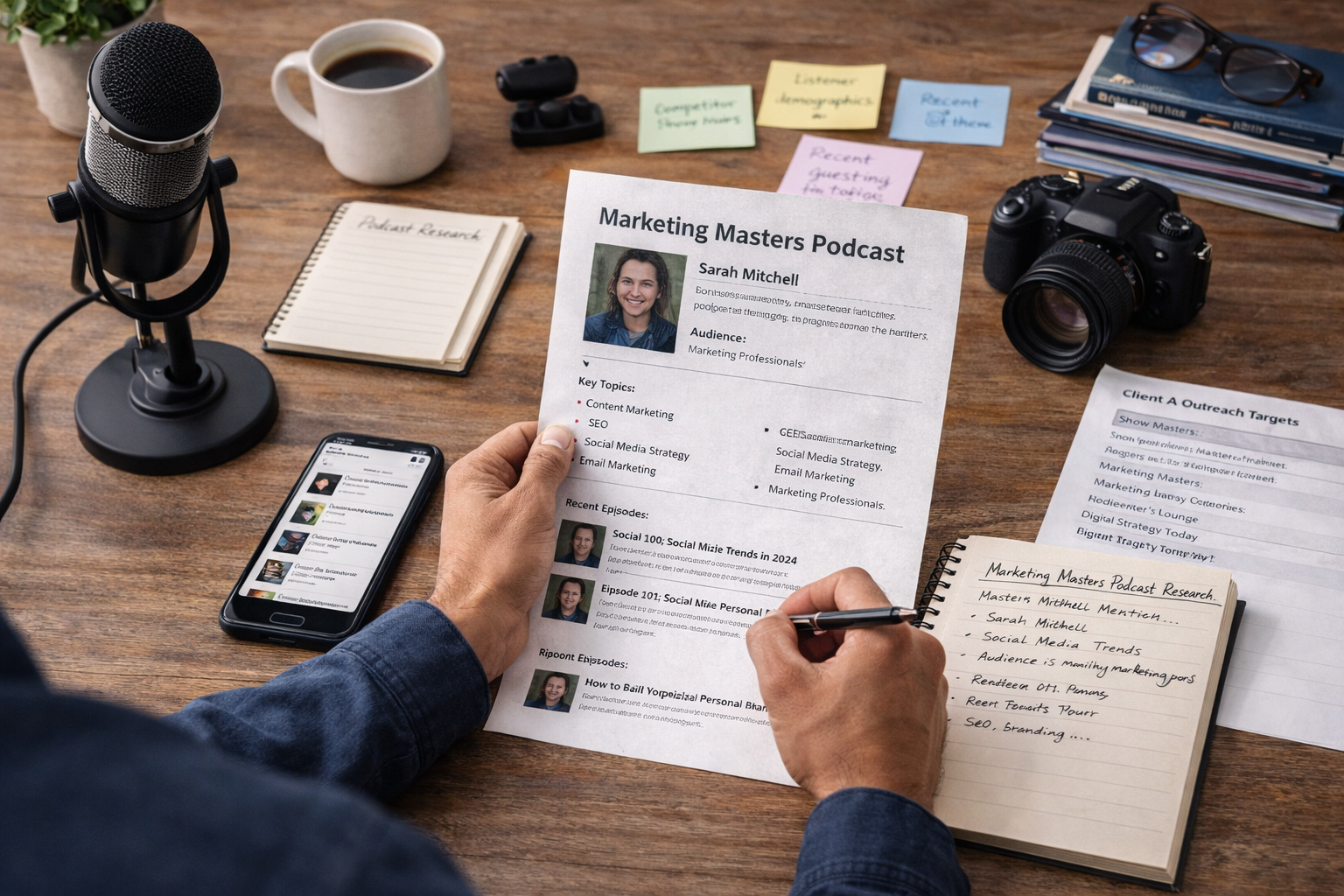
Quick answer: a podcast is a good fit for your client when its audience is the one your client needs to reach, there is a specific conversation the host hasn't already had, its recent guests look like your client, and the appearance serves a clear PR objective with no brand-safety red flags. Check booking odds as part of fit: a show your client can't realistically land is not a fit yet. Podseeker scores every podcast against each of your clients with Client Fit, shows each show's booking difficulty, typical guest credentials, and recent guests, and explains the fit in writing on every drafted pitch.
Listener size comes after all of that. In Podseeker's State of Podcast Pitching 2026 report, very high-fit pitches booked 4.7 times as often as very low-fit ones, while shows above 100,000 listeners per episode booked none of 171 pitches.
How Should a PR Professional Decide Whether a Podcast Is a Good Fit for a Client?
Decide fit before you write anything. Check the eight factors below; a strong candidate passes all of them, one weak answer means investigate further, and any brand-safety red flag means no, whatever else the show offers.
| Factor | Good fit | Weak fit | How to check |
|---|---|---|---|
| Audience | The people your client needs to reach: buyers, peers, investors, or recruits | A general or unrelated audience, even if large | The show's description, recent topics, reviews, and media kit |
| Conversation | A specific angle the show hasn't covered recently | The topic was just covered, with nothing new to add | The last 10 episode titles and descriptions |
| Guest level | Recent guests have credentials like your client's | Guests are mostly far better known than your client | Recent guests and the show's booking difficulty |
| Active interview show | Recent episodes on a regular schedule, with outside guests | No episode in months, or solo and co-host episodes only | The latest episode date and the last 10 episodes |
| Strategic value | Serves a defined objective: thought leadership, a launch, leads, or recruiting | No objective beyond "more podcasts" | The client's brief and campaign goals |
| Host and brand safety | A credible host who represents guests fairly | Misinformation, hostile edits, or controversial affiliations | Two recent episodes and a search on the host |
| Reach | Right-sized for the objective, with believable numbers | Inflated or unverifiable audience claims | Listener estimates; ask for a media kit when it matters |
| Booking route and logistics | A named host, producer, or guest form; a format that suits the client; no fee | Pay-to-play, or a live format the client isn't ready for | Contact details, show format, and any guest fees |
Why booking odds belong in the fit decision
Most fit checklists stop at audience and topic. The data says to check whether the show will book someone like your client, too. In Podseeker's analysis of 6,546 pitches sent April 11 to August 11, 2026 (outcomes observed at least 60 days later):
- Fit changes outcomes at every level. Very high-fit pitches booked 4.7 times as often as very low-fit pitches, and at the same booking difficulty, fit roughly doubled the booking rate. On hard-to-book shows, that was the difference between about 1 booking in 500 pitches and about 1 in 25.
- Bigger shows rarely book. Pitches to shows with 10,000 to 100,000 listeners per episode booked at 0.3%, and shows above 100,000 booked none of 171 pitches.
- Guest level matters. Shows that usually book accessible professionals booked 4.5% of pitches; shows that book public intellectuals booked 0.4%.
A weighted fit scorecard
To compare shows consistently, score each factor from 1 (poor) to 5 (excellent), multiply by the weight, and add up to a score out of 100. These weights are a suggested starting point, not an industry standard; adjust them to the campaign.
| Factor | Weight | What a 5 looks like |
|---|---|---|
| Audience | 20 | Exactly the people the client needs to reach |
| Guest level and booking odds | 20 | Recent guests look like the client; low or medium booking difficulty |
| Conversation | 15 | A specific, timely angle the show hasn't covered |
| Strategic value | 15 | Directly serves the campaign objective |
| Host and brand safety | 10 | Credible host, fair interviews, no concerns |
| Reach | 10 | Right-sized for the objective, with believable numbers |
| Active show, booking route, and logistics | 10 | Publishing weekly with guests, a named contact, and an easy format |
As a rule of thumb, pitch shows that score 75 or more, investigate shows from 55 to 74, and skip the rest for this client. A brand-safety red flag overrides any score.
The final check: why this show, why this client, why now?
- Why this show? Name the audience and the angle that make it worth the client's time.
- Why this client? Name the expertise, data, or story only your client brings.
- Why now? Tie it to a launch, a trend, a news hook, or the client's current priority.
If you can't answer all three in a sentence each, research more before you pitch. After the episode airs, judge it against the objective you set, so the next fit decision is better informed.
By hand or in Podseeker
| Fit question | By hand | In Podseeker |
|---|---|---|
| Does the audience and topic match? | Read descriptions and recent episodes | A Client Fit score for each of your clients on every podcast, and Recommendations of high-fit shows for each client |
| Will they book someone like my client? | Compare the client with recent guests | Booking difficulty, typical guest credentials, and recent guests on every podcast page |
| Is the reach right? | Media kits and public charts | Listener estimates per episode, with a Listeners filter |
| Is it an active interview show? | Check the latest episode and guest history | Active and Has guest filters |
| Who do I pitch? | Website, RSS feed, LinkedIn | Host and producer contacts with each person's role and a confidence level |
| Has the host opted out? | Look for notes on the show site | Shows whose hosts asked not to be pitched are flagged |
| Final check before sending | Your own judgment | Each drafted pitch shows a fit rating and a one-sentence reason comparing your client with the show's typical guests and booking difficulty |
Scores are a starting point: confirm the angle and the booking contact yourself before pitching. To build a list your client can realistically land, see how to find mid-sized podcasts to pitch your clients.
What Podcast Research Should Establish
A polished email cannot compensate for an irrelevant guest or an unsuitable format. Research helps you decide whether to send the pitch at all.
Research serves two purposes:
- Qualification: Is this podcast right for your client? Does the audience match? Is the show active? Does the host interview guests at all?
- Personalization: Can you reference something specific that proves you've done the work? A recent episode, a recurring theme, the host's interview style?
Use what you learn to choose a useful conversation. You do not need to open every pitch with a compliment or an episode reference; the proposed angle should demonstrate relevance.
Start with Fit, Not Fame
It's tempting to chase downloads. But a million listeners don't matter if they're not your client's audience.
Before researching any individual show, get clear on who you're trying to reach. Not your client's expertise. Their target audience.
Ask:
- Who is the customer your client is trying to reach?
- What problems do they have?
- What other content do they consume?
A cybersecurity consultant's target audience might listen to IT leadership podcasts, not general business shows. A parenting book author might reach more of the right people on a mid-sized show for working moms than on a massive productivity podcast.
Find Relevant Podcasts, Then Research the Shortlist
Start with searches for the client's expertise, the audience they serve, and the problems they can explain. Check relevant episode topics and where comparable guests have appeared. In Podseeker, narrow database results by activity, guest format, and listener estimates, or review client-matched Recommendations.
Save promising shows, then use the checklist below to confirm fit and choose a pitch angle. For the full discovery process, see how to find podcasts for a client, or how to find podcasts to be a guest on for your own appearances. Keep source links and research notes in your podcast media list.
The Research Checklist
For every podcast you're considering pitching, gather this information before writing a single word.
1. Basic Show Information
Is the show active? Check the most recent episode date. Compare the latest episode with the show's normal schedule. Check for a seasonal break or an announced return before treating it as inactive.
Does the show have guests? Not all podcasts feature interviews. Some are solo commentary, co-hosted discussions, or narrative formats. If recent episodes contain no outside guests, check the show's guest guidelines before spending more time on a pitch.
What's the format?
- How long are episodes?
- Is it conversational or structured?
- Does the host ask rapid-fire questions, deep-dive on one topic, or cover multiple subjects?
This shapes how you position your client. A 20-minute tactical show needs different topic angles than a 90-minute deep conversation.
2. Audience Analysis
Who listens to this show? Look for clues in:
- The podcast description
- How the host introduces episodes
- The types of guests they feature
- Topics they return to repeatedly
- Comments and reviews
If the show describes itself as “for startup founders” or “for HR professionals,” that establishes its intended audience. Guest patterns, comments, and reviews provide additional clues, but they do not establish the actual listener demographics.
How large is the audience? Record listener estimates per episode with their source and date. Keep them separate from lifetime downloads, subscribers, video views, and social followers. Use estimates to prioritize research rather than treating them as verified host analytics.
Does this audience match your client's target? Be honest. A loose match isn't a match. You're looking for shows where your client's expertise directly serves the listeners' needs.
3. Content History
What topics have they covered? Scan the episode archive. Note recurring themes and any obvious gaps. You want to propose something that fits their wheelhouse but hasn't been done recently.
If they recently covered personal branding, check what the conversation actually addressed. Offer a distinct angle or new evidence instead of repeating it. Some shows revisit themes regularly.
Who have they had as guests? Look at the last 20-30 guests:
- What's their profile? (Executives, authors, practitioners, academics?)
- What expertise do they bring?
- Are there any guests similar to your client?
Compare those guests with your client honestly. If every recent guest is a bestselling author or a well-known executive and your client is earlier in their career, the show is likely out of reach for now. Podseeker shows each podcast's booking difficulty and its guests' typical credentials, so you can make this call quickly.
If a competitor or similar expert appeared recently, you might need a differentiated angle, or you might skip this show for now.
What questions does the host typically ask? Many hosts have signature questions or a predictable structure. Knowing this helps you prep your client and shows the host you've actually listened.
4. Host Research
What's their interview style? Listen to at least one full episode, ideally two or three. Note:
- Do they let guests talk at length, or do they interject frequently?
- Are they challenging or supportive?
- Do they follow a script or go where the conversation leads?
- What seems to energize them?
What do they care about beyond the podcast? Check their LinkedIn, X, or personal website. What are they posting about? What topics get them engaged? This context helps you connect personally in your pitch.
Have they stated preferences for pitches? Some hosts publish guidelines. Some mention on the show how to reach them. Some explicitly say what they're looking for in guests. Find this before pitching.
5. Practical Details
How do you contact them? Options include:
- Email (often in show notes or website)
- Contact form on podcast website
- Social media DMs
- A guest application or booking link explicitly intended for prospective guests
Follow the show's stated submission route. A producer's email or an official guest form may be the right choice. A public calendar link alone is not an invitation to schedule an interview. For more on finding the right contact, see the fastest way to get podcast contact information.
Who handles booking? Larger shows have producers. Mid-sized shows are often host-managed. Pitching the right person matters. Check the website or show credits.
Is the contact appropriate and current? Save the source page, recipient's role, and date checked. An RSS email may belong to someone who configured the feed. Deliverability verification checks whether an address is likely to receive mail; it does not establish that the person handles guest invitations or wants the pitch.
Are there conditions to discuss with the client? Check published guest requirements, recording arrangements, promotional expectations, and any participation fees. Resolve these before agreeing to an appearance.
Where to Find This Information
The Podcast Itself
The most valuable research comes from listening. Episode archives, show notes, and episode descriptions contain most of what you need.
You don't need to listen to every episode. But you should listen to enough to genuinely understand the show. Start with a relevant recent episode or transcript and inspect others when you need more context. Listen to the audio when assessing interview style, and do not claim to have listened if you only read a summary.
The Podcast Website
Many shows have "About" pages, guest archives, and contact information. Some list past guests with links, making it easy to see patterns.
Social Media
The host's LinkedIn, X, or Instagram often reveals what they're currently interested in, what content gets engagement, and sometimes direct calls for guest pitches.
If you're pitching a business podcast, the host's LinkedIn activity is often more useful than their podcast feed for understanding what they care about right now.
Podcast Directories
Apple Podcasts, Spotify, and other directories show episode frequency, recent activity, and listener reviews. Reviews sometimes reveal what the audience values most.
Podcast Databases
Professional podcast databases aggregate show information, contact details, audience data, and episode history. They can significantly speed up the research process, especially when you're building a media list across multiple shows.
Podseeker is a podcast database and search engine for teams getting clients booked. It brings show research, listener estimates, Client Fit, contact information, and outreach into one workflow. Recommendations are matched to a client profile and can be filtered by estimated listeners per episode. Use those signals to prioritize shows, then check recent episodes and the original contact source before pitching.
Podseeker researches public contact routes, uses Contact enrichment to fill gaps, automatically enriches campaign targets with no recipient, and offers manual Concierge contact lookup for remaining gaps. These are distinct processes; a contact's source, role, and email verification should be evaluated separately.
When choosing a research tool, compare podcast databases on contact quality and research context, and podcast search engines on how well they help you discover relevant shows.
A Worked Research Example
Suppose your client helps family businesses plan an ownership transition. Search for “business succession,” “family business,” and “selling a company,” then review relevant shows and client-matched Recommendations within your chosen listener-estimate range.
For each candidate, save a short research note:
- Audience evidence: The show describes its audience as business owners; recent episodes address ownership and management decisions.
- Content evidence: A recent interview covered valuation. Check whether succession planning has already been explored.
- Proposed angle: Practical succession mistakes the client has encountered and can discuss with permission.
- Contact evidence: The official guest page names a producer and provides submission instructions.
- Decision: Pitch if the angle and guest credentials fit; otherwise investigate or move the show out of this campaign.
This is an illustrative process, not a claim about a particular show. Replace each note with evidence from the podcast you are researching.
What the Outreach Benchmarks Tell Us About Fit
Podseeker's measured results support giving high-fit shows closer attention. They do not prove that a particular amount of research causes a booking or that a high score guarantees acceptance.
| Metric | Observed result | Measured sample |
|---|---|---|
| High-fit booking rate (85%+ Client Fit) | 6.2% | 55 bookings / 894 pitches |
| Overall booking rate | 3.3% | 165 bookings / 5,012 pitches |
| Bookings per month (median) | 8 | 4 campaign months; 200+ pitches/month |
The booking-rate cohort covers post-trial pitches from active organizations sent February 27–June 28, 2026, with outcomes observed August 27. Internal organizations, automated users, trial-period pitches, and void pitches were excluded. The high-fit group is a subset of the overall cohort, defined by an 85%+ Client Fit score.
The monthly median focuses on active Podseeker customers sending 200+ initial pitches in a month. It represents selected high-activity campaign months, not the entire customer base. The four qualifying April–June 2026 months produced 5, 6, 10, and 20 booked pitches, with outcomes assessed September 8. Bookings are attributed to the sending month even when replies arrived later; the AI booking classification includes coordinating recording logistics.
These are observed results, not guarantees for each client or calendar month. The monthly sample is separate from the high-fit cohort. See the booking benchmark methodology for eligibility, plan limits, and calculation details. Competing products may measure matches, messages, placements, or coverage, so compare their definitions before comparing results.
How to Use Research in Your Pitch
Use research to make the proposed conversation specific and useful to the show's audience.
Reference Something Specific
Don't say "I love your show." Say which episode you listened to and what resonated. Only reference details you have checked, and explain why they matter to the proposed conversation.
Bad: "I'm a big fan of the podcast."
Better: "Your recent conversation with [Guest] about [Topic] stood out, especially the point about [Specific Detail]. That's actually connected to something my client could expand on."
Align Your Topic to Their Themes
Don't pitch a generic topic. Pitch something that fits their established content patterns while offering a fresh angle.
If they cover leadership regularly but haven't addressed remote team culture, that's a gap. If they had a guest on AI last month, maybe hold that pitch or find a non-overlapping angle.
Anticipate Their Questions
If you've listened to enough episodes, you know the host's style. You can proactively address what they'll want to know: why should their audience care?
Frame your pitch around listener value, not your client's credentials. Credentials matter, but only in service of what the audience gets. For a deeper look at what hosts prioritize, see what podcast hosts actually want in a guest pitch.
Show You Understand Their Audience
Reference who listens. “Your show focuses on [stated audience or topic]. My client’s experience with [verified example] could help listeners understand [specific problem].”
This signals that you're not pitching blindly. You've thought about fit.
How Much Research Is Enough?
Use a quick qualification pass before investing in deeper listening. First check activity, guest format, topic relevance, and the contact route. Then examine a relevant episode or transcript and the client's proposed contribution. Spend more time where the opportunity or remaining uncertainty justifies it.
You are ready to draft when you can explain who the show serves, why this guest belongs, what they can add, and how to approach the booking contact. Save supporting links so another team member can review the decision without repeating the work.
Templates can help organize a pitch, but every message still needs an accurate guest angle and an appropriate recipient. Neither a small list nor a large one is inherently effective; qualify the targets and track the results.
When to Pause or Skip a Show
- Unclear activity: Check season announcements or current guest instructions before pitching.
- No evidence of guest interviews: Confirm whether the format accepts outside contributors.
- Audience mismatch: Remove it from this client's campaign even if it suits another client.
- Repeated topic: Develop a distinct contribution or hold the pitch.
- Unclear booking route: Research the official website and producer information before sending to an unrelated address.
- Unacceptable conditions: Resolve fees or commitments with the client before proceeding.
Research Is Respect
Ultimately, research is a form of respect. It says to the host: I value your time. I understand what you've built. I'm not treating your show as a checkbox.
That attitude comes through in every pitch you send. Hosts notice.
The work you put in before the pitch often determines whether they ever read past your subject line.
For turning research into effective pitches, see podcast pitch templates and examples. For the follow-up strategy after you've sent a well-researched pitch, see how to follow up without being annoying.
Frequently Asked Questions About Podcast Fit and Research
How should a PR professional decide whether a podcast is a good fit for a client?
Check that the show is active and interviews guests, that its audience is the one your client wants to reach, that recent guests have credentials similar to your client's, and that there is a specific angle the host hasn't covered. Then check booking odds: in Podseeker's analysis of 6,546 pitches, fit roughly doubled the booking rate at every level of booking difficulty. Confirm a real booking contact and that the appearance serves the client's objective. Listener size comes after relevance.
Can a tool tell me whether my client is a good fit for a podcast?
Yes, as a first pass. Podseeker scores each of your clients against a podcast with Client Fit, from Very low to Very high, and shows the show's booking difficulty, typical guest credentials, and recent episodes. Use the score to decide which shows to research first, then confirm the angle and contact yourself.
Does a bigger podcast mean a better fit?
No. A large show whose guests are much better known than your client is a weaker target than a mid-sized show whose guests have similar backgrounds. In Podseeker's outreach data, pitches to podcasts with 85%+ Client Fit booked at 6.2%, compared with 3.3% across all pitches.
How long should podcast research take per show?
A few minutes for the first pass: activity, guest format, topic match, and booking contact. Spend more time, such as listening to a full episode, only on shows that pass. A fit score can shortlist the candidates before you start.
What should I do with a podcast that isn't a good fit?
Remove it from this client's campaign rather than forcing a pitch. It may suit another client, or the same client later once they have more appearances or a timely angle.
Start your free Podseeker trial to find relevant shows, research contacts, and manage the outreach campaign.



Try us risk free with a FREE 3 days trial.